
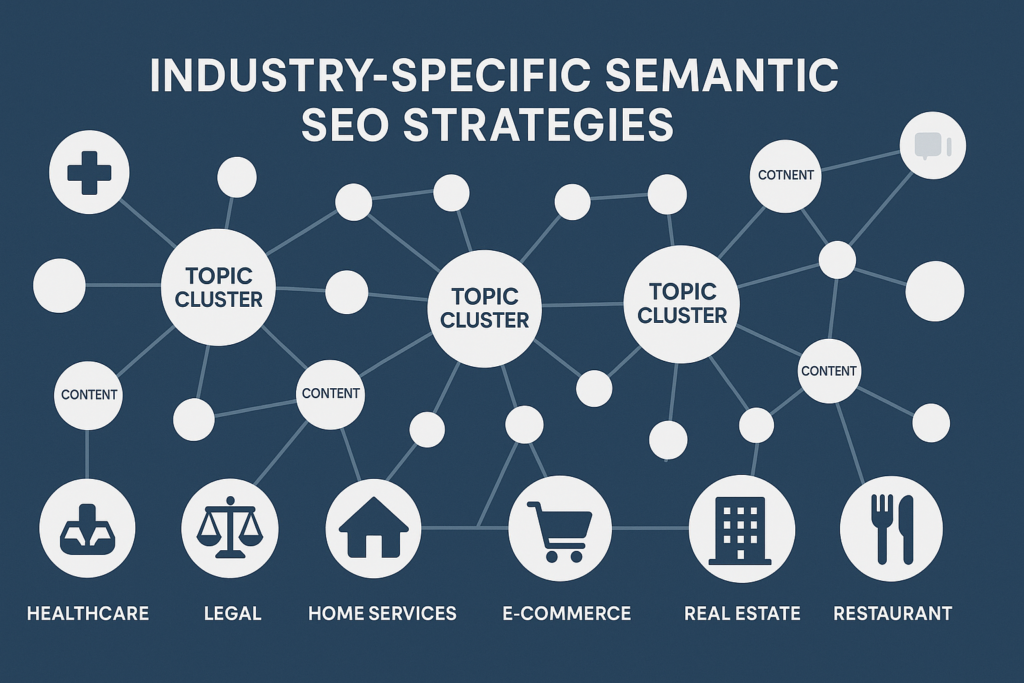
Quick answer: Semantic SEO is covering one subject with a hub page and supporting pages that answer the next questions, then linking them with plain anchor text. Google and AI answers pull from that set, not from a page that repeats one keyword.
A page that says "plumber" thirty times still loses to a site that answers cost, emergency hours, and which towns you cover. That is semantic SEO: the meaning of the topic, not the phrase count.
Ranking posts in 2026 still describe a hub and spokes. What they skip is the decision of which spoke deserves its own URL, and what to do when two pages already fight over the same query. This is that missing part, with a New Jersey service business as the example.

What semantic SEO actually changes
Google groups a query with related questions. "Laser hair removal near me" sits next to price, pain, how many sessions, and which towns. If your site answers one of those and ignores the rest, you rank for a fragment.
AI Overviews do the same thing in public. They stitch an answer from several pages. A single keyword page gives them nothing to stitch. A cluster does.
Hub, spoke, and the page you should not split
Use three layers, and stop there:
- A hub that defines the service and links to every spoke.
- Spokes for questions that need different proof: price, process, location, comparison.
- A bottom-of-funnel page that asks for the call or the booking.
Do not split a spoke just because a tool listed a synonym. "Laser hair removal cost" and "how much is laser hair removal" can live on one page. "Laser hair removal Edison" cannot, if you have a real office there and the advice changes by location.
Search Engine Land's cluster guides stop at the diagram. They rarely say what to merge. Merge when the search results for two phrases are the same pages. Split when the results are different, or when the reader needs a different next step.
A New Jersey example: one clinic, six pages
Take a MedSpa in New Jersey. The hub is the treatment. Spokes that earn their own URL:
| Page | Question it answers | Why it is separate |
|---|---|---|
| Hub: laser hair removal | What it is and who it is for | The entry point |
| Cost | Price per session and packages | People comparing before they call |
| How many sessions | Timeline | Different intent from price |
| Town page | Where you are and parking | Local pack and "near me" |
| Aftercare | What to do the next day | Existing clients and featured snippets |
| Book | The form | The page you want the links to support |
Link the hub to each spoke in the first screen, and link each spoke back to the hub and to the booking page. Sideways links only when the reader would click: cost to "how many sessions," not cost to aftercare.
How Donna Bella's keyword spread fits this
Donna Bella Laser, a MedSpa client, had low local rankings, thin traffic, and few appointment requests. After the SEO work, more than 60 keywords sat on the first page of Google, and the clinic was generating 60 or more high-ticket leads a week. That spread is what a cluster looks like in Search Console: not one vanity phrase, a set of related queries landing on the right URLs.
The same pattern shows up outside New Jersey. Storeganise, a self-storage software company Saif works with through Rank and Trend, reached number 1 for "self storage software." One product term, supported by pages that answer the comparison and the how-to, not a single stuffed homepage.
Build the cluster in a week
- Export queries from Search Console for 16 months.
- Group them by the page that should answer them. If two queries need different proof, they are different rows.
- Open an incognito search for the two phrases. If the top 10 overlap heavily, keep one URL.
- Write the hub first, then the spoke that already has impressions and a weak page.
- Add the internal links the same day you publish. A spoke with no link from the hub will not inherit the topic.
Checklist
- Hub states the service in the H1 and links to every spoke
- Each spoke answers one question in the first 50 words
- Synonyms that share a SERP are on one URL
- Town or location pages exist only where you can serve the customer
- Booking or contact page is linked from the hub and the money spokes
- Search Console query-to-page map is reviewed monthly
When two URLs already fight
Open Search Console, filter to the query, and look at Pages. If two of your URLs both get impressions, you have a split. Do this in order:
- Read both pages. Keep the URL that answers the question in the first screen and has the clearer title.
- Move any unique paragraph from the loser onto the winner. If nothing unique is left, the loser was a duplicate.
- Change internal links so they point at the winner. The anchor should be the question, not "click here."
- 301 the loser to the winner. A canonical tag alone is a hint. A redirect is a decision.
- Wait a month. If the winner's impressions rise and the loser drops to zero, the merge worked.
Do not merge a town page into a state page. "Laser hair removal Hoboken" and "laser hair removal New Jersey" can share a SERP for a while and still deserve two URLs, because the proof is different: the street, the parking, the hours at that door.
A New Jersey site often collects these splits by accident. A service page, a blog post from 2023, and a location page all mention the same treatment. Pick one owner per query and make the other two link to it.
The same rule is how the rest of Saif's site is organized: one subject per URL, then a link to the next question.
FAQ
Is semantic SEO different from topic clusters?
Topic clusters are the site structure. Semantic SEO is the reason the structure works: search engines match meaning, so related pages reinforce one subject. You need both.
How many spokes does a cluster need?
As many as there are distinct questions with different search results. Five solid spokes beat twenty near-duplicates.
Will AI Overviews use a cluster?
They pull short answers. A spoke that states the answer in the first sentences is easier to cite than a page that buries it under a story.
Can a local New Jersey business do this without a national blog?
Yes. The hub can be the service, and the spokes can be cost, process, and the towns you actually cover. That is enough.
If your Search Console queries are landing on the wrong URLs, that is the cluster problem. Book a call with Saif and bring the query export. Related: how topical authority is earned and voice and near-me queries.
